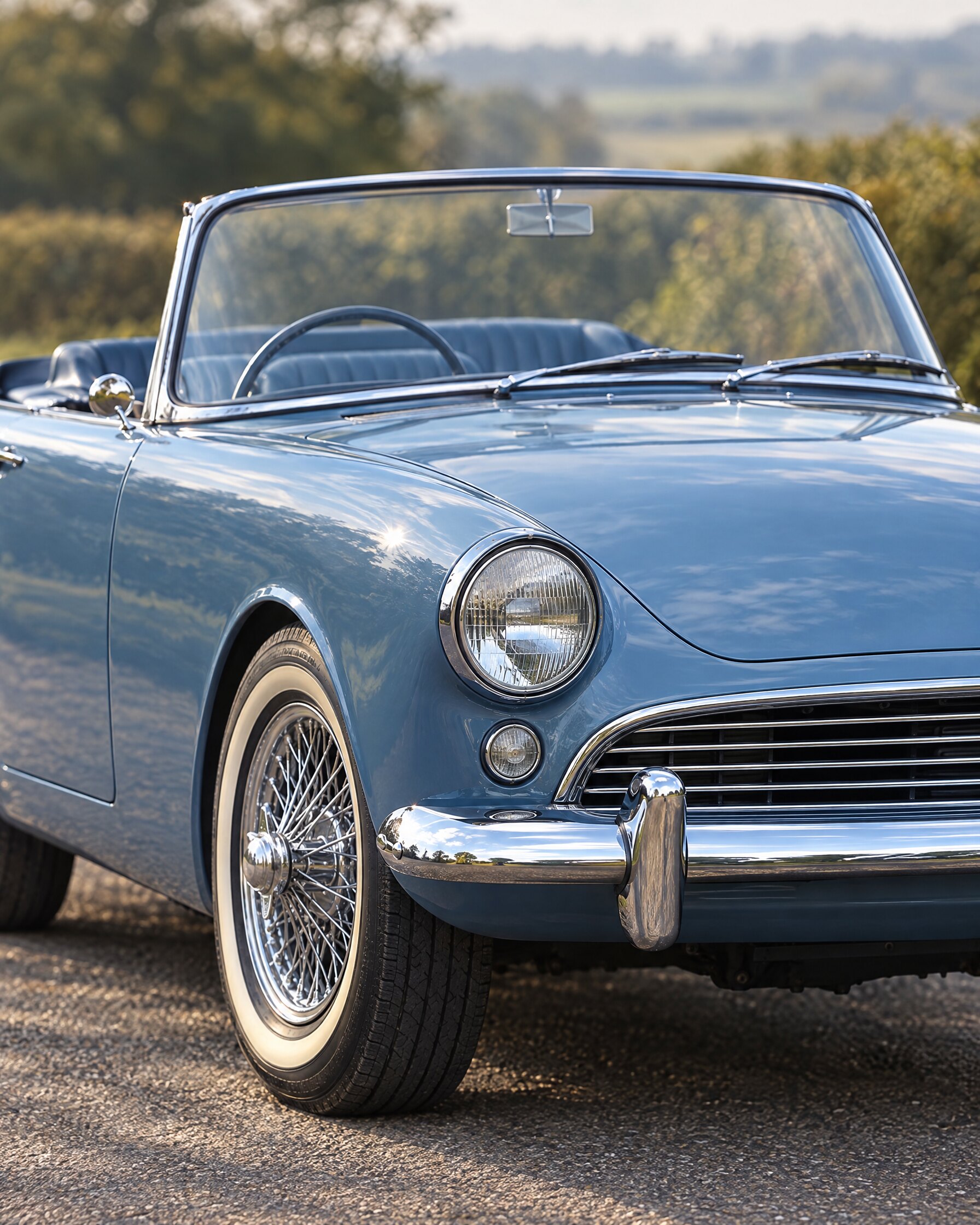
Bond’s first car on screen was not an Aston Martin. According to our catalogue source it was a small blue roadster from the Rootes Group, with wire wheels and white-wall tyres: the Sunbeam Alpine Series II. Ian Fleming gave the car to someone else, and the film handed it to Bond. If you want a first-generation Bond car with a very different character from the Astons that followed, the Sunbeam Alpine Series II is the one to look at.
In the books
In Fleming’s novel Dr. No, the Sunbeam Alpine belongs to Commander Strangways, and it is black. The film turns it Lake Blue, with matching upholstery, and puts Sean Connery’s Bond behind the wheel. It is worth knowing that the car most people picture is the film’s, not the book’s. More cars from the Bond stories are collected under the films.
The details of the Sunbeam Alpine Series II
A bigger engine. The Series II of 1960 enlarged the engine to 1,592cc and 80bhp, and revised the rear suspension. Little else changed, which is the point: it refined a car that already worked. Production ended in 1963 after 19,956 had been made.
Disc brakes at the front. The Alpine used wishbone front suspension and front discs, the first disc brakes on a Rootes Group car. Classic & Sports Car describes the body as a stiff monocoque, built on cruciform chassis legs, which made the Alpine unusually refined for a sports car of its day.
Options that make the look. Overdrive on third and top gave six speeds. A curved aluminium hardtop, a heater, a tonneau cover and wire wheels were all extras. The wire wheels are what put the car on screen.
What it was like in period. The Motor tested a Series II with hardtop and overdrive in 1960 and recorded a top speed of 98.6mph, 0 to 60mph in 13.6 seconds and 31.0 miles per imperial gallon. The test car cost £1,110 including taxes. It is a car for the road rather than the stopwatch.
Owning it now
The Alpine is out of production and found second-hand. Classic & Sports Car rates the Series II and the Series V as the most desirable in standard specification. We would look for a Series II with wire wheels and overdrive, in a blue close to the film’s, and we would take a specialist with us. The soft-top tucks away neatly but is never easy to raise and lower, brakes can seize if the car is little used, and the front suspension needed frequent greasing up to 1964. Some cars have had engine swaps, so check that the unit is the right one.
Specifications
| Model | Sunbeam Alpine Series II sports tourer roadster, made by the Rootes Group |
|---|---|
| Production | 1960 to 1963; 19,956 built |
| Engine | 1,592cc, 80bhp, alloy-head four-cylinder |
| Brakes and suspension | Front disc brakes; wishbone front suspension |
| Options | Overdrive, aluminium hardtop, heater, tonneau cover, wire wheels |
| Period test | 98.6mph; 0 to 60mph in 13.6 seconds (The Motor, 1960) |
| Film car | Lake Blue with matching upholstery, wire-spoke wheels, white-wall tyres |
| Price new (test car) | £1,110 including taxes, 1960 |
Questions
Is the Sunbeam Alpine in Dr. No a Series II?
Yes. Our catalogue source and the James Bond Wiki identify the film car as a 1961 Sunbeam Alpine Series II, a two-door roadster.
What colour is the Sunbeam Alpine in the book?
Black. Fleming’s Commander Strangways drives a black Sunbeam Alpine in the novel; the blue car belongs to the film.
Is the Sunbeam Alpine still made?
No. The Series II was replaced in 1963, and the Alpine is found second-hand. Our link searches eBay for current examples.
How fast is a Sunbeam Alpine Series II?
The Motor’s 1960 test of a Series II with hardtop and overdrive recorded 98.6mph and 0 to 60mph in 13.6 seconds. Treat it as a relaxed open car rather than a quick one.
More cars and objects from the stories are in our vehicles guide, and the film pages show where each appears.