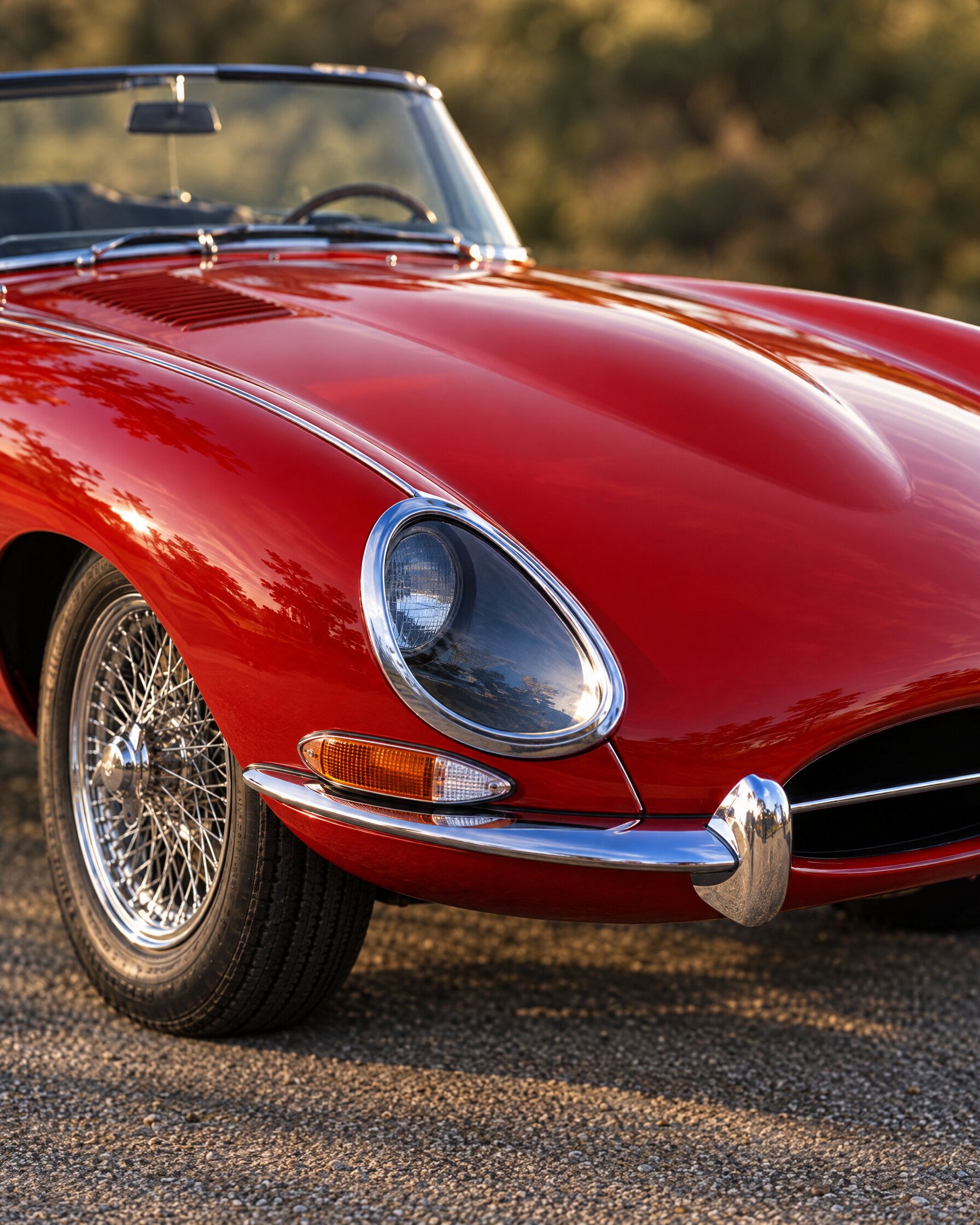
The Jaguar E-Type turns up in Bond’s world twice, and in different ways. In the film Thunderball a red E-Type sits outside the Shrublands health clinic, parked beside a Rolls-Royce. In the continuation novel Carte Blanche it is named among the brands in the opening of Chapter 6. For anyone who wants a Bond-adjacent classic with an unmistakable shape, the Jaguar E-Type is the one that needs least explaining.
In the books
Jeffery Deaver’s Carte Blanche mentions a 1960s Jaguar E-Type among the brands at the start of Chapter 6. On screen, the red E-Type in Thunderball is a background car: our catalogue notes that it belonged at the time to the Bond production designer Ken Adam. It does not appear in Fleming’s own novels, so we call it Bond-adjacent rather than a Bond car. See the rest of the stories under the films.
The details of the Jaguar E-Type
The shape. Malcolm Sayer designed the E-Type, and Jaguar built it in Coventry from March 1961 until the mid-1970s. In North America it was sold as the XK-E. The first production model was the open two-seater with the 3.8-litre engine.
The numbers. Jaguar claimed a top speed of 150mph and acceleration to 60mph in under seven seconds. That was extraordinary for the early 1960s, and it is why the car’s reputation has outlasted every road test.
Construction. A largely unitary body, independent suspension at both ends and a front-engined layout made the E-Type advanced for its day. The line from D-Type to E-Type is plain to see, and Jaguar lists the D-Type and the XK150 as its predecessors.
The factory route. Jaguar Classic restores E-Types to 1960s factory specification through its E-type Reborn programme, with build records and original drawings held by the Jaguar Heritage Trust. Owners choose a 3.8 or 4.2-litre engine and a fixed-head coupé or open two-seater body. Small upgrades are made quietly: electronic ignition, a high-torque starter, a stainless steel exhaust and an alloy radiator. Every Reborn car carries a one-year warranty.
Owning it now
The original E-Type is out of production, and Jaguar Classic’s restored cars are sold by enquiry, so our button goes to the Jaguar Classic page rather than a basket. Used cars vary widely. Classic.com’s market page gives an average sale price of US$97,782 across recorded sales, with the highest recorded sale at US$21,090,000 for a 1964 car in January 2026; those figures are at the time of writing, October 2026. We would choose a car for its history and its paperwork before its colour, though a red one has the right company in Thunderball.
Specifications
| Maker | Jaguar Cars Ltd, Coventry |
|---|---|
| Production | March 1961 to the mid-1970s |
| Designer | Malcolm Sayer |
| Body | Open two-seater and fixed-head coupé |
| Engine (first model) | 3.8-litre six-cylinder |
| Claimed performance | 150mph; 0 to 60mph in under seven seconds |
| Factory restoration | E-type Reborn: 3.8 or 4.2-litre, open or coupé, one-year warranty |
| Market figure | Average recorded sale US$97,782 (Classic.com, October 2026) |
Jaguar describes its restoration programme on the Jaguar Classic E-type Reborn page.
Questions
Is the Jaguar E-Type a Bond car?
Not in Fleming’s books. A red E-Type appears in Thunderball and a 1960s E-Type is named in the continuation novel Carte Blanche, but Bond does not drive one.
Whose red E-Type is in Thunderball?
Our catalogue records that it was owned at the time by Ken Adam, the film’s production designer, and that it is parked in front of Shrublands next to the Rolls-Royce.
How fast is a Jaguar E-Type?
Jaguar claimed 150mph, with 0 to 60mph in under seven seconds, for the early cars.
Can I buy a restored E-Type from Jaguar?
Yes, by enquiry. Jaguar Classic builds E-type Reborn cars to 1960s specification with a one-year warranty.
More Bond-adjacent cars are in our vehicles guide, and the Bonds shows who drove what.