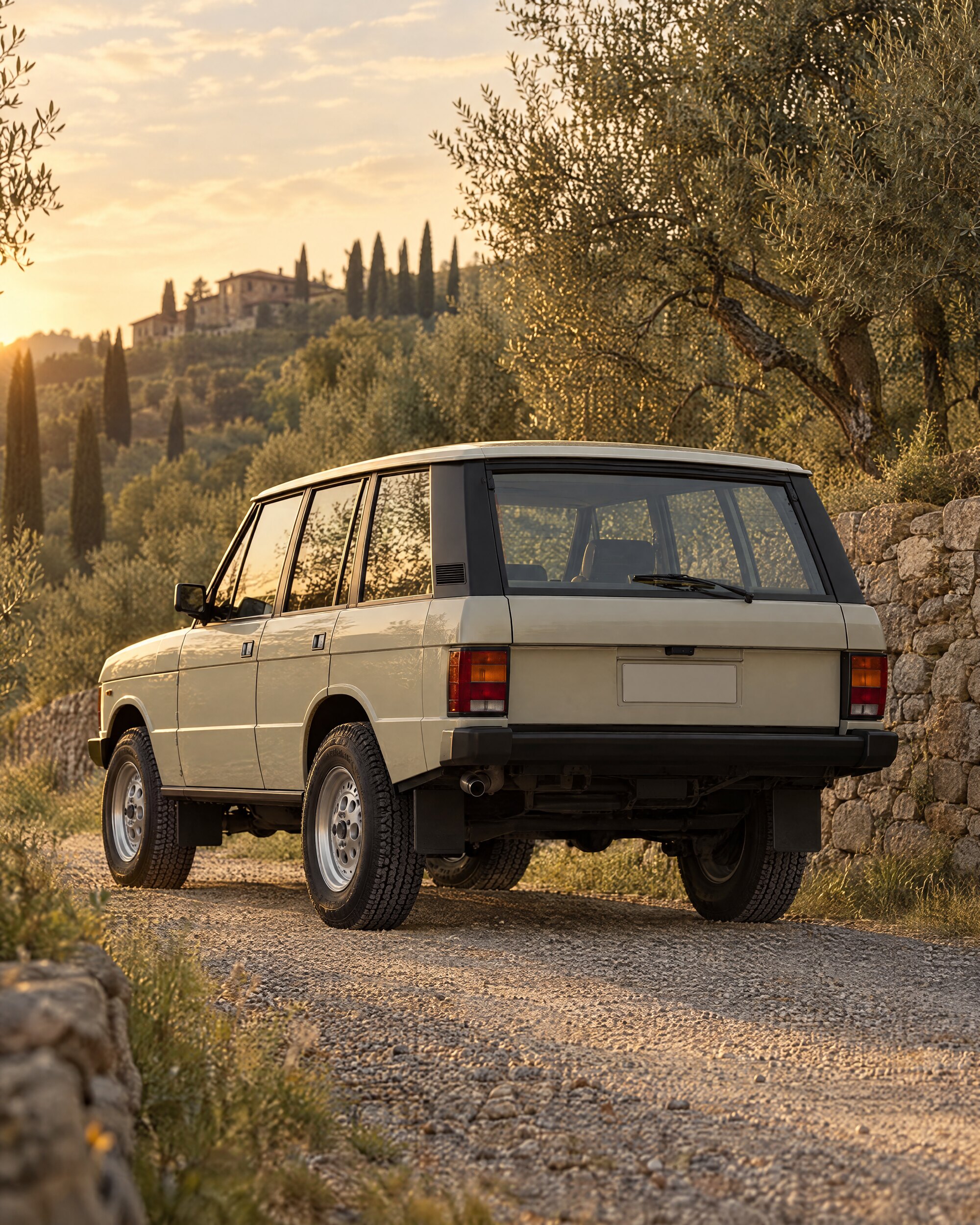
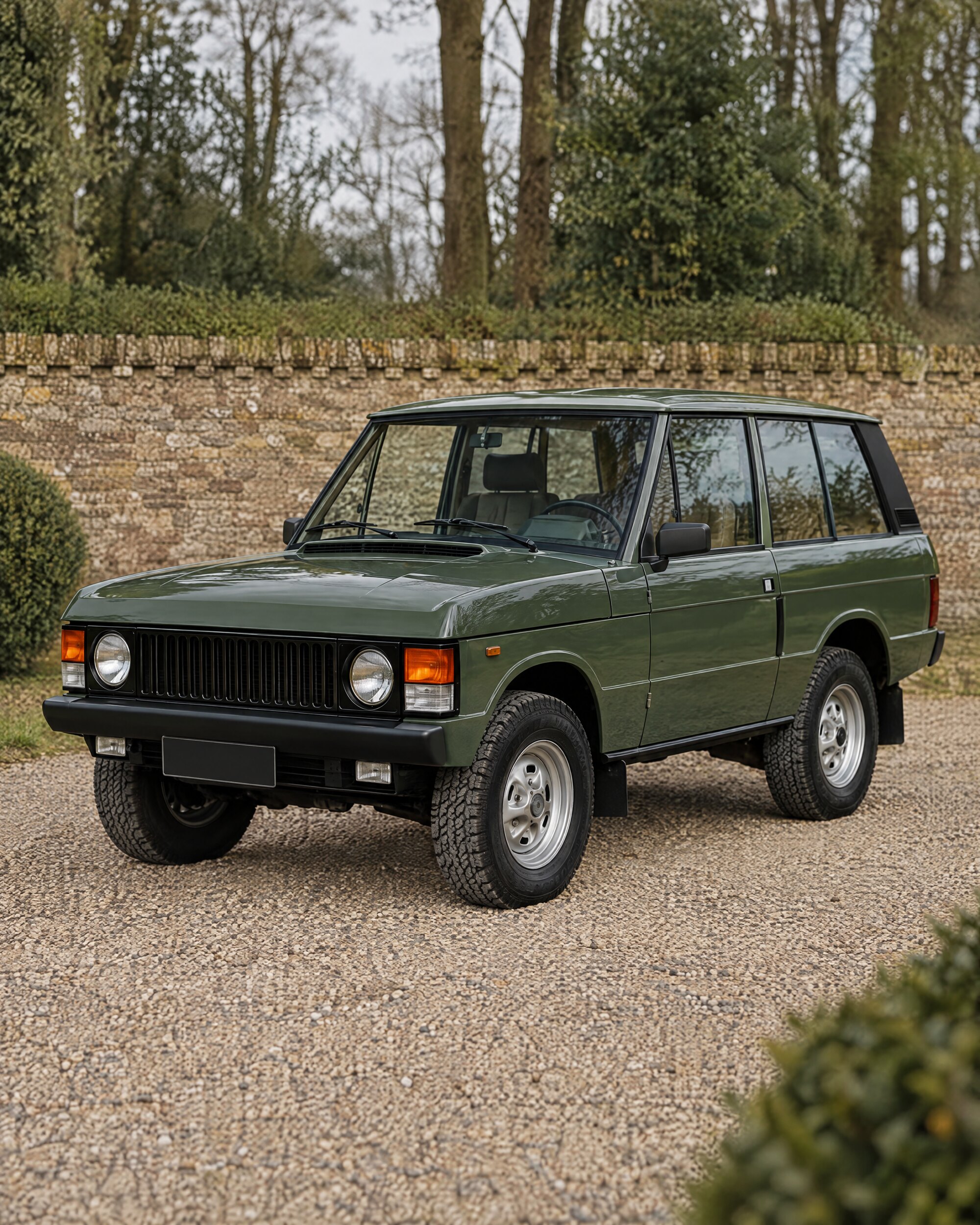
The Range Rover Classic in No Time To Die is the original Range Rover, built at Solihull from 1970 to 1996. It appears among a modern Land Rover line-up that includes the new Defenders, the Range Rover Sport SVR and a Series III. It is no longer made new, but in our view it is one of the more sensible old cars a man can buy.
In the film
Jaguar Land Rover lists the Range Rover Classic among the vehicles in No Time To Die, and our notes place it in a scene set in Italy. Nothing we have says whether Daniel Craig’s Bond drives it, or which year and specification of car was used. We do not claim that any car for sale is the one on screen.
The details of the Range Rover Classic
A long production run. Built at Solihull from 1970 to 1996, with 326,070 made in total. The shape was drawn up in 1967 by Spen King, Gordon Bashford and David Bache, and it changed little over almost three decades.
The name came later. “Classic” was added in 1994, when the P38A successor arrived and the two were briefly built alongside each other. Land Rover applied the name retrospectively to every first-generation car. Anyone searching for a Range Rover Classic is looking for the original.
The Rover V8. Petrol cars used a 3.5-litre V8, later joined by 3.9 and 4.2-litre versions. Diesel versions used VM Motori and Land Rover four-cylinder turbodiesels, in 2.4 and 2.5 litres. Transmissions ranged from four- and five-speed manuals to three- and four-speed automatics.
Two lengths. The short wheelbase measures 2,540mm and the long 2,743mm. Overall length is 4,445mm or 4,648mm. Width is 1,781mm throughout.
Quicker in the end. The 1995 cars reduced the 0 to 60mph time to around 11 seconds, with a top speed of about 110mph. That is brisk enough for modern roads, though no one buys this car for speed.
Owning it now
The Classic suits a man who wants a car that is useful and understated, not one to be admired in a garage. We would not dress it up. It looks best clean, unmodified and in a quiet colour.
Which one? Our view is that the later cars are the ones to look for. The 3.9- and 4.2-litre V8s are the sensible petrol choice, and the last major interior change came in 1994. Whichever you choose, buy on condition and paperwork, not on the story. A car with a documented history and no heavy modification is worth more than a lower mileage and a repaint.
Price. It is no longer sold new, so there is no RRP. Recent Bring a Trailer results, as of October 2026, ranged widely. A 1992 County SE sold for US$16,125 and a 1995 County Classic LWB for US$50,000, while a heavily modified 1995 car reached US$115,000. Condition, specification and modification all matter. Our button runs an eBay search for the model, where eBay Motors listings appear.
Specifications
| Production | 1970 to 1996; 326,070 built |
|---|---|
| Assembly | Solihull, United Kingdom (also Australia and Venezuela) |
| Body | 3- or 5-door off-road vehicle |
| Petrol engines | 3.5, 3.9 and 4.2-litre Rover V8 |
| Diesel engines | 2.4 and 2.5-litre VM Motori turbodiesel; 2.5-litre 200Tdi and 300Tdi |
| Transmission | 4-speed or 5-speed manual; 3-speed or 4-speed automatic |
| Wheelbase | 2,540mm (short); 2,743mm (long) |
| Length | 4,445mm (short); 4,648mm (long) |
| Width | 1,781mm |
| Height | 1,801mm (1970 to 1980); 1,781mm (1980 onwards) |
| RRP | Not sold new; used prices vary (see above, October 2026) |
The maker’s history of the model is on Range Rover’s own Classic page.
Questions
Does a Range Rover Classic appear in No Time To Die?
Yes. Jaguar Land Rover lists it among the vehicles in the film, and it appears in a scene set in Italy. The exact year and specification are not stated.
Can you still buy a new Range Rover Classic?
No. Production ended in 1996, so any Classic is a used car. Condition and history matter more than age.
What engines did the Range Rover Classic have?
Petrol cars used a Rover V8 of 3.5, 3.9 or 4.2 litres. Diesel cars used VM Motori or Land Rover four-cylinder turbodiesels of 2.4 or 2.5 litres.
Why is it called Classic?
Land Rover added the name when the P38A successor arrived. It was then applied retrospectively to all first-generation Range Rovers, to tell them apart from the new car.
More on the cars of the film is in our vehicles section, and on the actor in our pages on Daniel Craig.