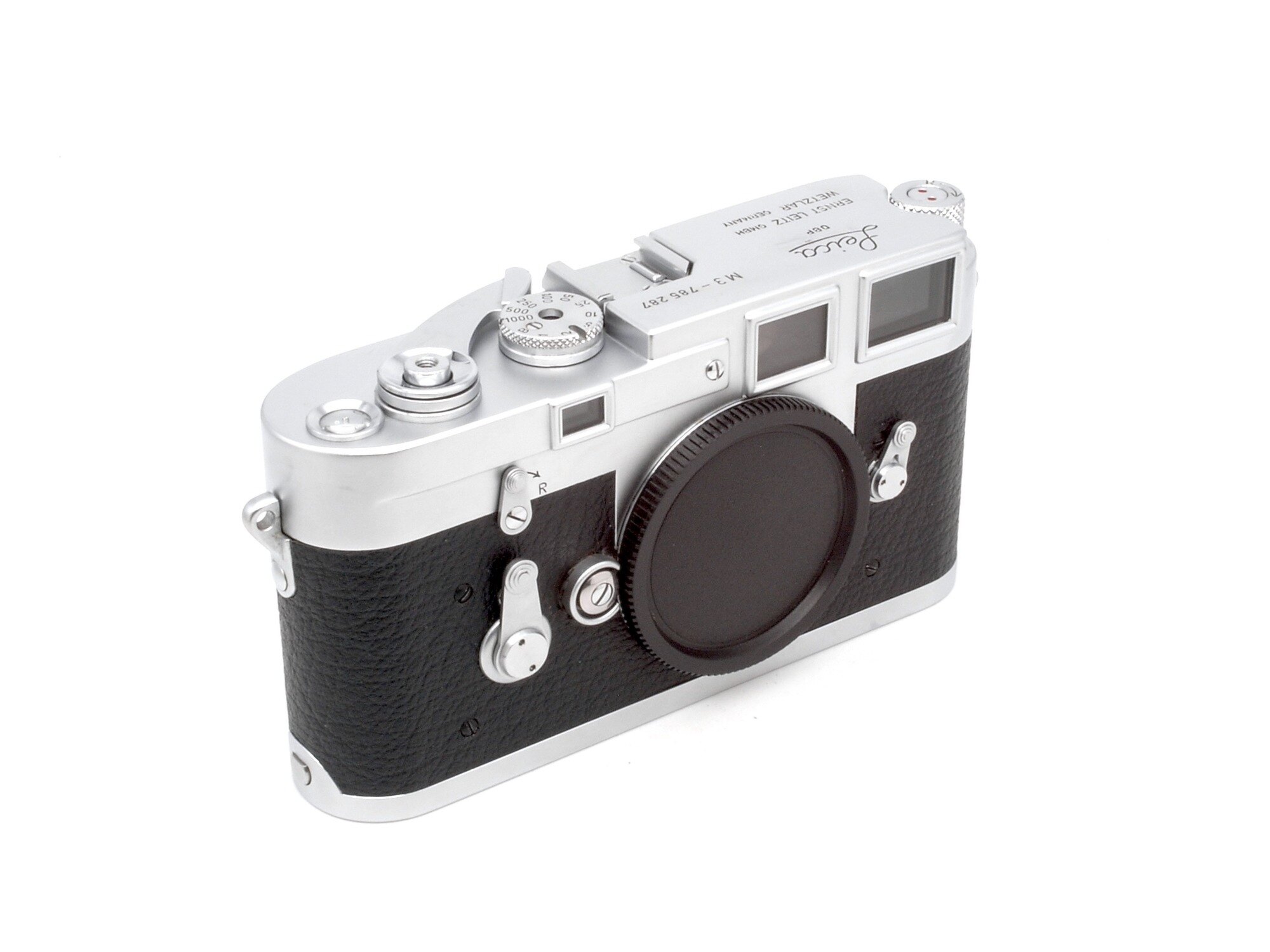
Bond’s camera in Goldfinger is as unflashy as he is. The Leica M3 is a 35mm rangefinder introduced in 1954, and Ian Fleming chose it for the moment Bond records how Auric Goldfinger cheats at cards. A Leica M3 is out of production but still very much alive, and it is the camera we would hand a newcomer to film.
In the books
In Ian Fleming’s novel Goldfinger, Bond takes an M3 Leica from his suitcase to photograph Goldfinger’s methods. It is a working tool in the story, not a gadget.
The details
The viewfinder. A single bright viewfinder window shows the rangefinder patch and a choice of three sets of frame lines, so you frame and focus at once. The M3 was the first of the Leica M series, named from Messsucher, the German for rangefinder.
The controls. A thumb-lever advance replaced the wind-on dial, the back is hinged for easier loading, and shutter speeds are set from a single dial on the top plate. The shutter and winding are quiet, which suits street work.
The build. The body is brass, with chrome-plated top and bottom plates and a vulcanite covering. One reviewer describes it as having some heft. The bayonet M mount replaced the earlier screw mount, and the camera originally shipped with a Summicron 50mm f2 lens.
The numbers. Introduced in 1954 by Ernst Leitz GmbH, it sold more than 220,000 units before the M4 replaced it in 1967.
Owning it now
Buy from a source that has checked the camera. The Leica Classic Store lists refurbished M3 bodies, some noted as having a full CLA (clean, lubricate and adjust) and as single-stroke or double-stroke versions. That refers to the film advance: double-stroke cameras need two strokes of the lever. A reviewer in our research advises that, used daily, a well-kept M3 should last about a decade between services. It takes film, so budget for a roll and a lab. A 50mm lens is the classic starting point.
In the same spirit
An alternative, not the M3: the Leica M10 Black Chrome is a current digital rangefinder in the same family. More reading is in our books and media section, and the films page lists the Bond films.
Specifications
| Model | Leica M3, rangefinder |
|---|---|
| Introduced | 1954, Ernst Leitz GmbH |
| Format | 35mm film |
| Lens mount | Leica M bayonet |
| Viewfinder | Single window, three sets of frame lines |
| Body | Brass, chrome-plated plates, vulcanite covering |
| Production | About 220,000 or more; replaced by the M4 in 1967 |
| Price | Varies by condition; see the Leica Classic Store |
Questions
Does Bond use a Leica in Goldfinger?
Yes. In Ian Fleming’s novel he uses an M3 Leica to photograph Goldfinger’s cheating methods.
Is the Leica M3 still made?
No. It was replaced by the M4 in 1967. Refurbished cameras are sold through the Leica Classic Store and second-hand dealers.
Does it need film?
Yes. It is a 35mm film camera.