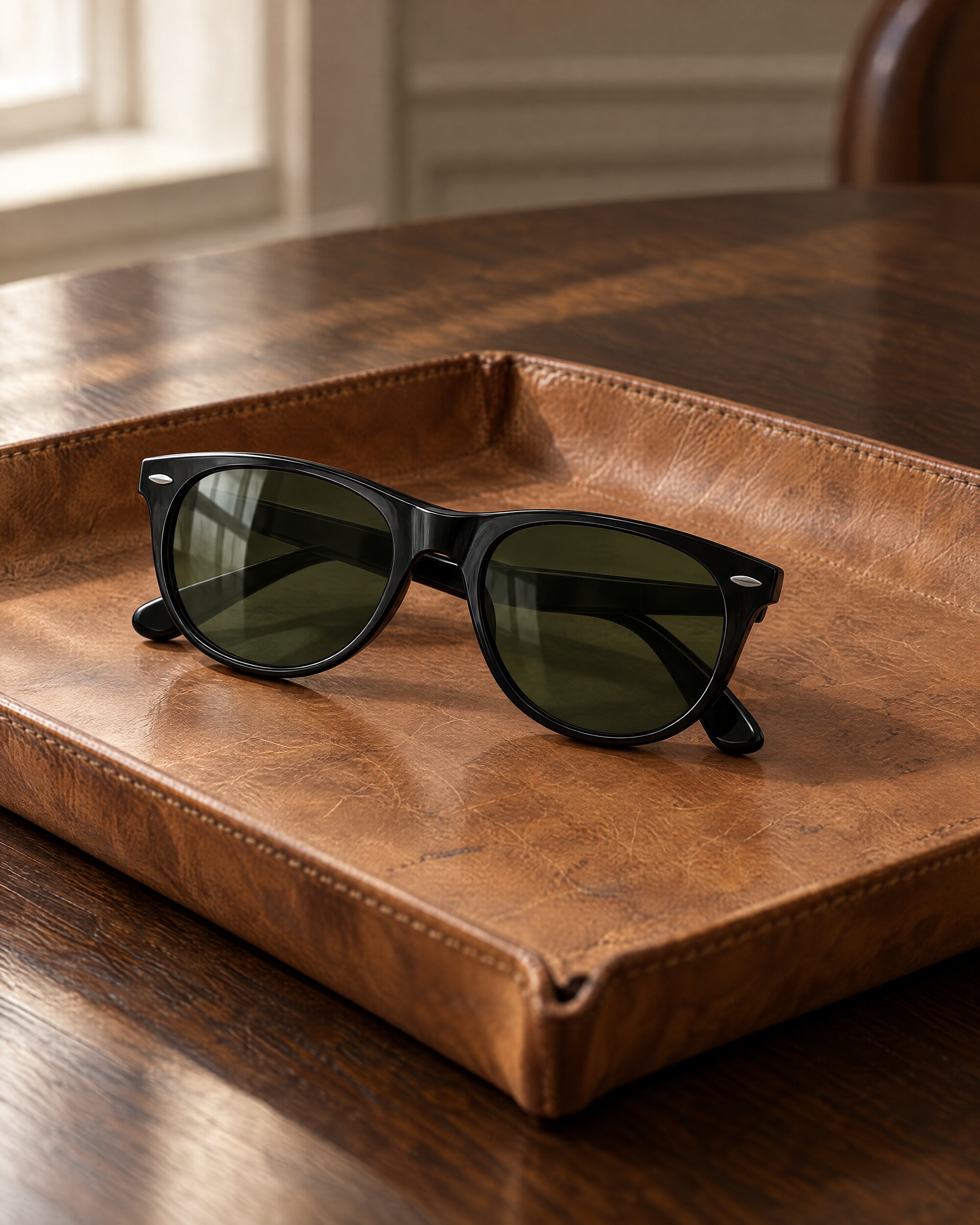
Some sunglasses earn their place by being quiet. The Ray-Ban Wayfarer II sunglasses are a slimmer reading of the Wayfarer: the same bold frame, with cleaner lines and a finer hand. In black acetate with green lenses, they are the sort of pair that goes with almost anything and is noticed for nothing in particular. Their history in Bond’s world is brief and a little tangled, so we have set out what is known and what is not.
In the film
The one confirmed Wayfarer II in the series belongs to a villain: Robert Davi’s Franz Sanchez wears a black pair in Licence To Kill (1989), when he leaves his villa by helicopter for the Olimpatec Meditation Institute and again on arrival. In No Time To Die, Jeffrey Wright’s Felix Leiter is reported in Ray-Ban Wayfarers in the Jamaican scenes, and a selfie taken on set shows them. We cannot confirm that they reach the screen, that they are the II, or that they are not Wright’s own pair. We treat the link as a possibility, not a fact.
The details of the Ray-Ban Wayfarer II sunglasses
A slimmer frame. Ray-Ban describes the Wayfarer II as having a slim acetate frame and skinny temples. In practice that means less visual weight on the face than the original, and a quieter presence.
Black acetate, green lenses. The current Classic is offered in polished black with G-15 green lenses, polarised or not, and Ray-Ban also lists brown lenses. Polarisation, Ray-Ban says, eliminates glare and increases clarity, which makes it a sensible choice for driving or the water.
Size and fit. The pair is listed in 55-18, meaning 55mm lenses and an 18mm bridge, with Ray-Ban’s High Bridge Fit. If you have a lower nose bridge, try them on before buying.
Vintage or current. The pair Sanchez wears dates from 1989, so a vintage pair is the closer match to the film. Condition and the seller matter a great deal. The Wayfarer II Ray-Ban sells today is the simpler route.
Wearing it now
A black Wayfarer is among the most forgiving sunglasses a man can own. It sits with a navy suit and an open-neck shirt, with a field jacket and chinos, and with a white tee at the water’s edge. We would choose the black frame with G-15 lenses over any coloured option, and polarised only if you drive or sail often.
Which one to choose. If you want the Sanchez look, a vintage pair is the faithful route, bought from a specialist who can show the lens condition and the frame in detail. If you want a pair to wear every day, the current Wayfarer II is the simpler and more practical choice. At the time of writing the Ray-Ban USA page for the polarised black pair showed it as sold out, so our button runs an eBay search for the Wayfarer II, where vintage and current pairs both appear. Ray-Ban’s own site is linked below for the current model.
For more on what appears on the faces of Bond’s world, see our guide to film eyewear, and the notes on No Time To Die and Daniel Craig’s Bond.
Specifications
| Model | Ray-Ban Wayfarer II Classic, RB2185 |
|---|---|
| Frame | Polished black acetate |
| Lenses | G-15 green, polarised or non-polarised |
| Size | 55-18, High Bridge Fit |
| Film variant | Vintage black Wayfarer II (Licence To Kill, 1989) |
| RRP | Not confirmed; check Ray-Ban’s page |
Full details are on Ray-Ban’s own site.
Questions
Does Felix Leiter wear Ray-Ban Wayfarer II sunglasses in No Time To Die?
It is not confirmed. Reports place a pair of Ray-Ban Wayfarers on Jeffrey Wright’s Leiter in the Jamaican scenes, but the evidence does not identify the Wayfarer II and the pair may be Wright’s own.
Who wore the Wayfarer II in a Bond film?
Franz Sanchez, played by Robert Davi, wears black Ray-Ban Wayfarer II sunglasses in Licence To Kill (1989).
How is the Wayfarer II different from the original Wayfarer?
It is slimmer. Ray-Ban describes a slim acetate frame and skinny temples, and retailers describe cleaner lines than the original.
Can you still buy a Wayfarer II?
Yes, though stock varies. Ray-Ban lists the model, but its polarised pair in polished black showed as sold out at the time of writing. Vintage pairs turn up with specialist dealers.
More in our guide to the films.