When you buy through links on this page we may earn a commission. It never decides what we write. How we work.
Most men who ask how to choose a dive watch have already looked at three and liked all of them. That is the right place to start, because the differences that matter are few, and they are mostly about your wrist and your week rather than the sea. This guide sets them out in the order we would weigh them, using the watches Daniel Craig’s Bond and his colleagues wear as reference points. The films supply the examples; the decision is yours.
The short answer
Choose the size first, then the strap, then the movement. Pick a case that sits within your wrist rather than over its edges, usually 40mm to 42mm for an average wrist. Take 200m or 300m of water resistance as more than enough. Look for a bezel and dial you can read at a glance, and decide whether you want a bracelet, a rubber strap or a NATO before you fall for a particular watch. Buy the one that suits the clothes you already own.
What a dive watch actually is
A dive watch is built to be read and to survive in water. It has a rotating bezel to track elapsed time, a screw-down crown that seals the case, luminous hands and markers that can be read in the dark, and a water resistance well beyond what a swimmer needs.
That presence is why the category has become the default sports watch, and why many are bought and never go near the sea. There is nothing wrong with that, but be honest about it: if you will never dive, legibility, comfort and proportion matter far more than a headline depth rating.
What the films show
The Bond films have put several dive watches on screen, and the verified record is more varied than the Seamaster legend suggests. In Casino Royale (2006), Craig’s Bond wears two Omega Seamasters: the Diver 300M, reference 2220.80.00, in steel with a blue wave dial, and a steel Planet Ocean with a black dial, black bezel and black rubber strap. In Spectre (2015), Q hands him the Seamaster 300 on a five-stripe NATO strap. In No Time To Die (2021), he wears the Seamaster Diver 300M 007 Edition, reference 210.90.42.20.01.001, in titanium on a mesh bracelet.
Others wear diver watches too. Primo, Blofeld’s henchman in the same film, wears a Hamilton Khaki Navy Frogman with a black dial and a rubber strap, first seen in the scene set in Matera. A dive watch is a type, not a brand.
Size and wrist presence
Case diameter is the number everyone quotes, but lug-to-lug length and thickness decide whether a watch sits well. A 42mm case with short lugs can wear smaller than a 40mm case with long ones. If the lugs overhang the edge of your wrist, the watch is too big for you, whatever the diameter says.
Thickness matters just as much. A dive watch of around 12mm to 15mm will not slide under a fitted cuff, so decide whether you mind. We would say that a man who wears a jacket and tie most days should look at the slimmer end, and one who lives in open collars and rolled sleeves has more freedom.
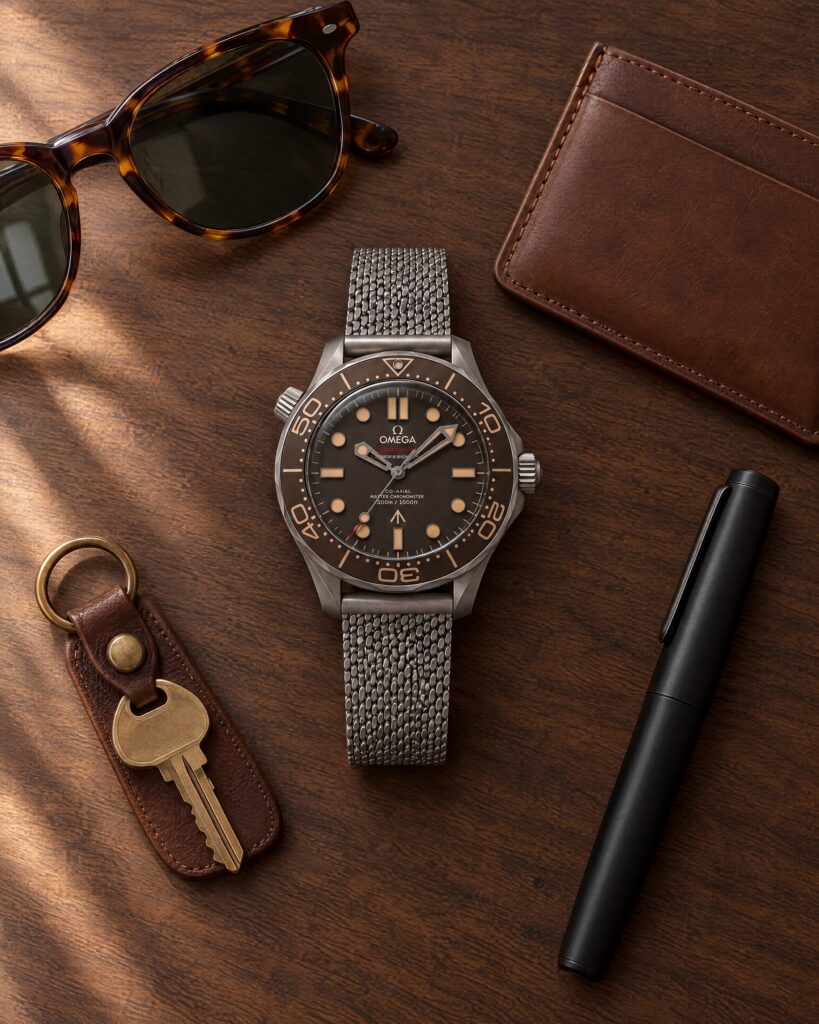
The Seamaster Diver 300M in the 007 Edition has a 42mm case in Grade 2 titanium, which Omega describes as strong yet lightweight. Titanium is the practical answer for a large watch: it carries less weight on the wrist over a full day. It is the watch Craig’s Bond wears in No Time To Die, and Omega describes it as identical to the one on screen.
Go larger and the sums change. Felix Leiter’s Speedmaster Racing in the same film is a chronograph rather than a diver, but it makes the point: at 44.25mm across and 14.92mm thick, it will not slip under a fitted cuff.
Water resistance in practice
The figure on the dial is a laboratory rating, not a depth you can take it to. For a man who swims on holiday, sails or showers in his watch, 100m is enough, and 200m or 300m is a generous margin. A rating of 300m, as on the Seamaster Diver 300M and the Hamilton Frogman, means you can wear the watch in the sea without a second thought.
What matters more is the construction behind the number. A screw-down crown must be fully screwed in before the watch gets wet. Gaskets age, so have an older watch’s seals checked. Leather straps and water do not agree; if you swim in your watch, choose a bracelet, rubber or NATO.
A modest rating is a sensible limit rather than a defect. The Omega De Ville Prestige worn by Moneypenny in No Time To Die is a quartz dress watch rated to 30m, enough for rain and hand-washing but not for swimming. It is not a diver, and does not pretend to be, which is a good reminder that the rating tells you what a watch is for.
Bezel and legibility
The bezel is the reason a dive watch is a dive watch. A unidirectional bezel turns only one way, so an accidental knock can only make a diver surface early, never late. A bidirectional bezel is more convenient on land. If you use it only to time a pan of eggs, what matters is that it clicks firmly and is easy to grip.
Legibility is the second half. A dive watch should be read in a glance, in poor light or a hurry. High contrast between hands and dial, a clear minute track and generous lume do the work. Black dials are the most legible. The brown of the Seamaster 007 Edition is softer, with a bezel ring in the same colour, which reads as quiet rather than stark. The black dial and bezel of the Hamilton Khaki Navy Frogman are made for plain reading: luminous hands and markers meant to be seen underwater, and a unidirectional rotating bezel.
Hamilton created the Frogman for US Navy diving teams, and at 42mm in steel, with 300m water resistance and an 80-hour power reserve, it is a practical watch that asks little of its wearer.
Bracelet, NATO or mesh
The strap changes the character of a watch more than the case does, and it is the cheapest decision to reverse. Here is how we would think about it.
Steel bracelet. The most versatile and the most durable. It dresses up and down, and it handles the water. The cost is weight and the occasional need to resize it.
Titanium mesh. Lighter and softer in line than a conventional bracelet, and it adjusts finely. It is the version Craig’s Bond wears in No Time To Die. Omega also sells the 007 Edition on a NATO strap for US$1,300 less, RRP at the time of writing, October 2026. We would choose the mesh: it is the version in the film, it dresses up as easily as down, and a NATO is simple to add later.
NATO. Cheap, replaceable and relaxed. It suits a casual wardrobe, adds colour without cost, and never needs sizing beyond a spare hole. A NATO also stays on the wrist if a spring bar fails, which is the reason it was designed that way. It sits a little higher on the wrist, so bear that in mind with a close cuff.
Rubber. The right answer for the beach, the boat and a hot city in August. The Frogman is shown on rubber in the film and we would keep it there. It is not a dinner jacket watch, but then no diver is.
Movement and service
Dive watches come with two kinds of movement. An automatic is wound by the motion of your wrist and has to be serviced every few years; the reward is a mechanism that runs without a battery. A quartz needs a battery every few years and little else, and it keeps correct time through a week in a drawer.
Within automatics, the figure to look at is the power reserve. The Frogman holds 80 hours, enough to see out a weekend on the dresser and still be running on Monday. Omega’s Calibre 8806 in the 007 Edition is a Co-Axial Master Chronometer. It is the kind of engineering you stop thinking about once the watch is on your wrist, which is the right way round.
Whatever you buy, ask what servicing costs before you pay. It belongs in the sum.
Bond’s Seamasters, verified
The Seamaster line is the one most people mean when they say Bond’s watch, and the record is worth stating carefully. In Casino Royale, Craig’s Bond wears the Seamaster Diver 300M 2220.80.00 in steel with a blue dial, which Omega no longer sells; it is a pre-owned purchase now. The same film features a Planet Ocean. In Spectre, the Seamaster 300 is worn on a NATO strap, and Omega describes the limited edition of 7,007 pieces as the watch from the film. Omega lists it as no longer available, so it too is a pre-owned buy. In No Time To Die, the 007 Edition in titanium is current in Omega’s range at the time of writing.
Bond’s watch has changed with each film, in material, bezel and strap. The common thread is restraint, which is a better guide to choosing than any single reference number.
Alternatives in the spirit of
You do not need to spend Omega money to buy a good diver. The Hamilton Khaki Navy Frogman is the plain answer: a steel diver with a naval lineage, 300m of water resistance and a long power reserve. It is what a working watch should look like, and it is the one that Primo wears, not Bond. Hamilton makes the Frogman in several sizes and colours, and only the 42mm reference H77605335 is the one in the film.
If the Seamaster appeals but the price does not, the steel-on-steel Seamaster Diver 300M (210.30.42.20.01.001) is a less costly route to a similar silhouette, at US$6,700 RRP at the time of writing, October 2026. It is not the watch from the film. A well-documented second-hand example is another option, provided the seller can show the box and papers.
What we would choose
For a man who wants one dive watch and will wear it most days, we would choose the Seamaster Diver 300M 007 Edition on the mesh. It is light, it is quiet, and the brown suits natural fabrics and earth tones. For a working, hard-wearing watch at a lower price, we would choose the Frogman on rubber and wear it in the sun with the sleeves pushed up. Neither is a dinner jacket watch.
Practical notes
- Check lug-to-lug length and thickness, not only diameter, and try the watch on with a shirt cuff.
- Screw the crown down fully before any contact with water, and have the seals checked on an older watch.
Questions
What size dive watch should I buy?
For most wrists, 40mm to 42mm is the safe range. Check the lug-to-lug length as well as the diameter, and the thickness if you wear fitted cuffs. If the lugs overhang your wrist, the watch is too large.
How much water resistance do I need?
For swimming, snorkelling and holidays, 100m to 200m is enough. A 300m rating gives you a wide margin and needs no thought. Keep the crown screwed down and have the seals checked as the watch ages.
Is a dive watch suitable for everyday wear?
Yes, which is the reason the category is so popular. A steel diver with a plain dial wears with a linen shirt, a knit and chinos, and in the right proportions under a jacket. The thicker cases are the limit under a close cuff.
Which Omega Seamaster does Bond wear?
It depends on the film. Craig’s Bond wears the Diver 300M 2220.80.00 and a Planet Ocean in Casino Royale, the Seamaster 300 in Spectre, and the Diver 300M 007 Edition, reference 210.90.42.20.01.001, in No Time To Die.
Is the Hamilton Khaki Navy Frogman a real dive watch?
Yes. It is water resistant to 300m and has a unidirectional rotating bezel and luminous markings meant to be read underwater. Hamilton created the Frogman for US Navy diving teams.
The pieces mentioned
- Omega Seamaster Diver 300M 007 Edition: titanium, 42mm, the watch Bond wears in No Time To Die.
- Hamilton Khaki Navy Frogman Auto H77605335: a plain steel diver at 42mm, worn by Primo.
- Omega Speedmaster Racing: a 44.25mm chronograph, worn by Felix Leiter, useful as a lesson in size.
- Omega De Ville Prestige Quartz 27.4mm: Moneypenny’s dress watch, and a reminder that not every watch needs to dive.
More watches from the films are in our dive watches and the wider watches collection, or start from No Time To Die.
Shop the story
 Omega Seamaster Diver 300M 007 Edition (No Time To Die)View the piece
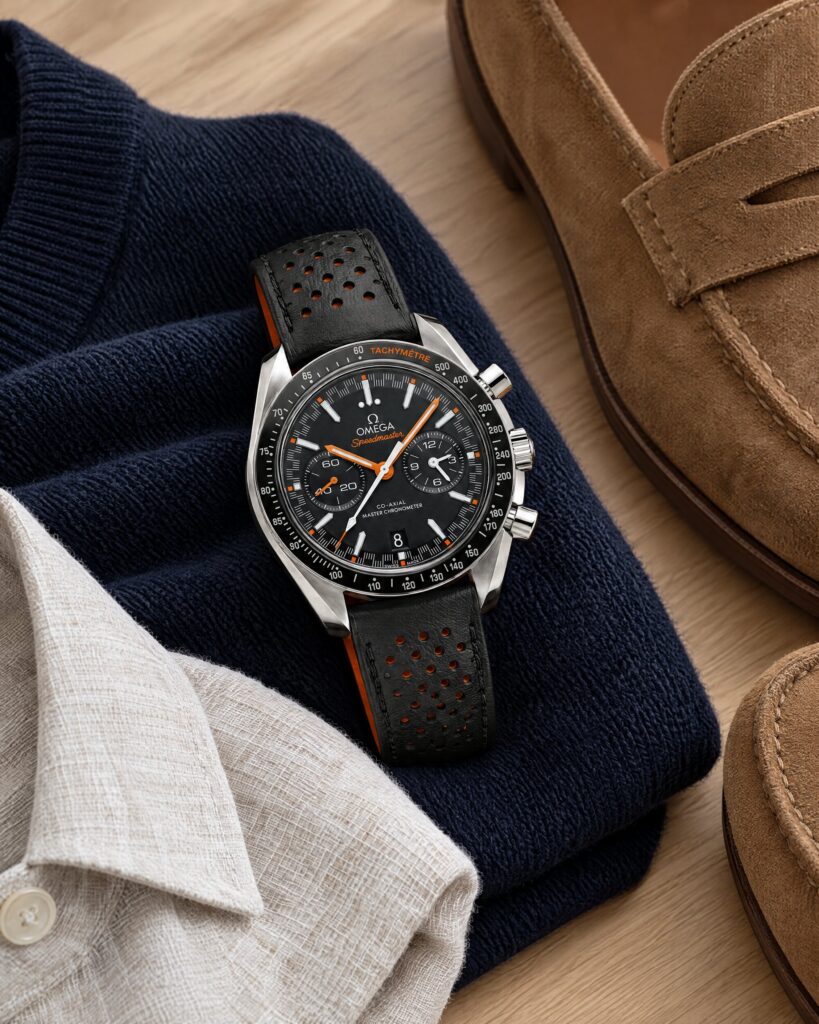 Omega Speedmaster Racing Co-Axial Master Chronometer Chronograph 44.25mm (No Time To Die)View the piece
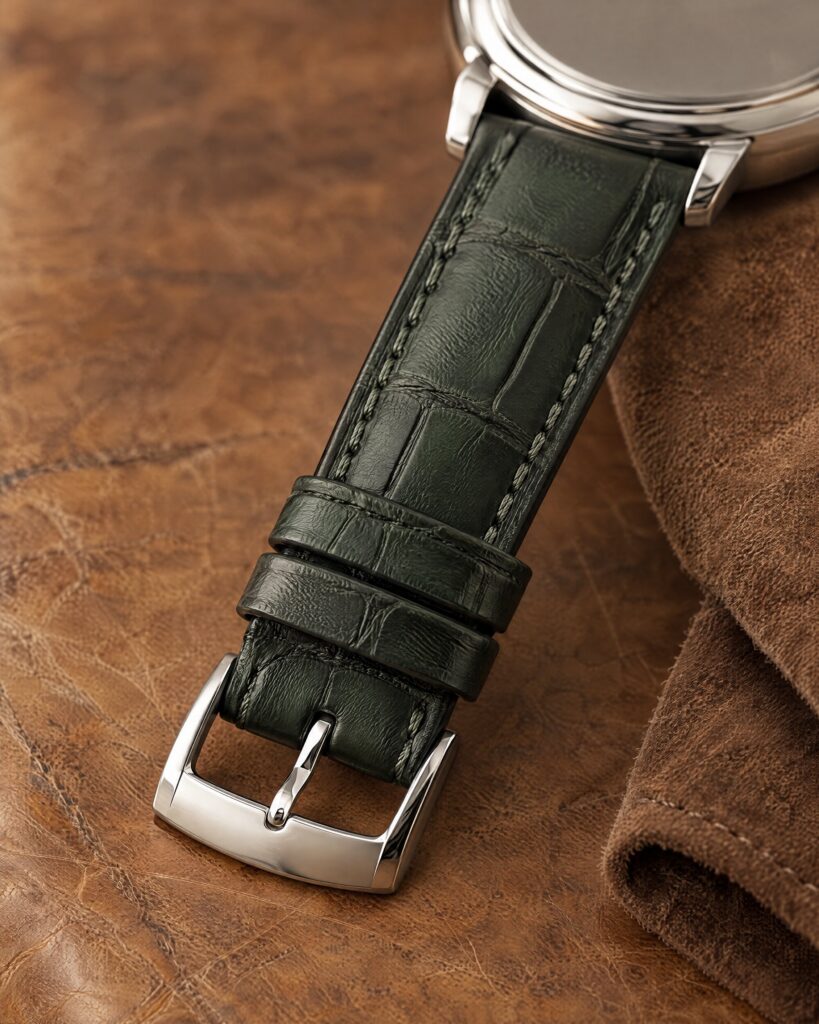 Omega De Ville Prestige Quartz 27.4mm Hunter Green (No Time To Die)View the piece
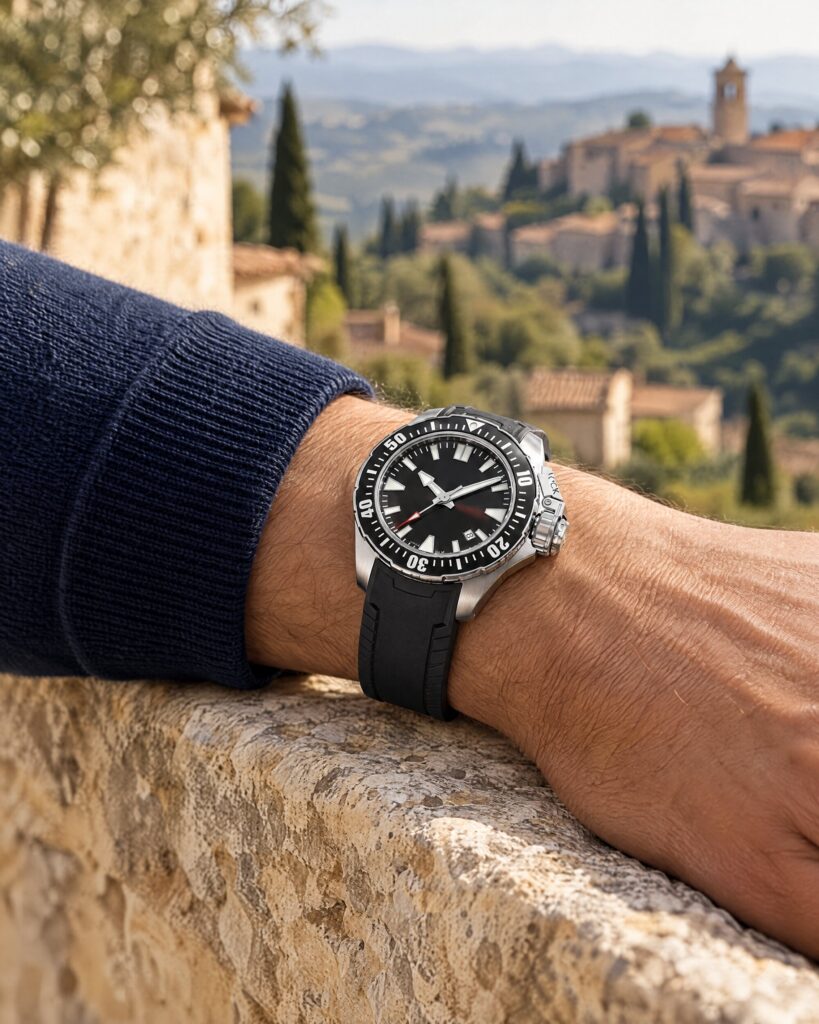 Hamilton Khaki Navy Frogman Auto H77605335 (No Time To Die)View the piece